How to get it right: Bolting timbers together correctly
07.08.2018

If you are doubling up floor joists, creating trimmers or trimming joists around stairs and chimneys they all need connecting properly so that they can act as a single unit.
Whilst timber floors and their connection details should be designed by a competent person, the ‘Eurocode 5 Span Tables (4th edition)’ published by TRADA offers good advice on typical connection details for solid timbers, such as the sizes of nails or bolts and their location and centres. Some of the key parts of this guidance document in relation to connecting trimmers or trimming joists are summarised below:
The nail specification used is dependent on the thickness of the timbers being used:
- 3.75mm diameter x 75mm long for 38mm wide sections
- 4.00mm diameter x 90mm long for 44mm and 47mm wide sections
- 5.00mm diameter x 125mm long for 63mm, 72mm and 89mm wide sections
The minimum bolt specification to be used is:
- M12 bolts (min. 3mm x 38mm M12 washers under head and nut) for 38mm, 44mm, 47mm and 63mm wide sections
- M16 bolts (min. 4mm x 48mm M16 washers under head and nut) for 72mm and 89mm wide sections
It may be possible to use other types of fasteners for which capacities have been obtained experimentally and declared by manufacturers with third party certification e.g. dog tooth connectors.
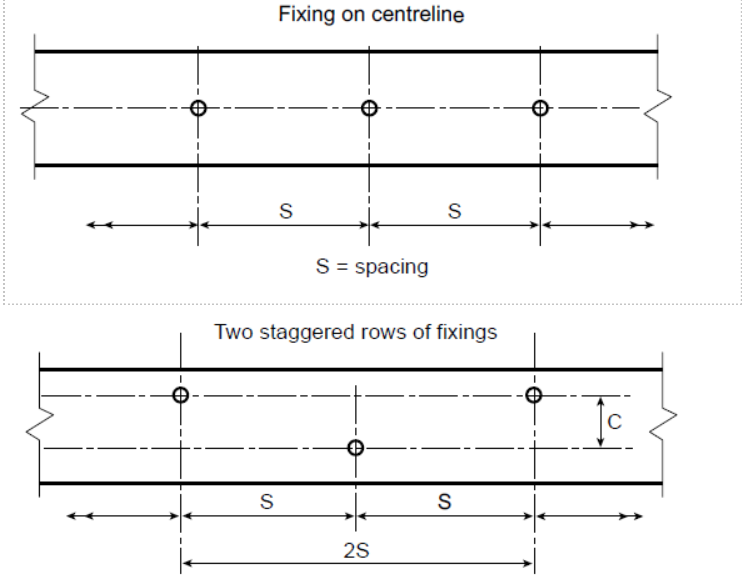
Fixing can be either along the centreline or staggered as shown in the diagrams below:
Nails must be a minimum of 15 times their diameter from the joist end and at least 5 times their diameter from the top and bottom.
Bolts must be a minimum of 7 times their diameter or 80mm from the joist end and at least 4 times their diameter from the top and bottom.
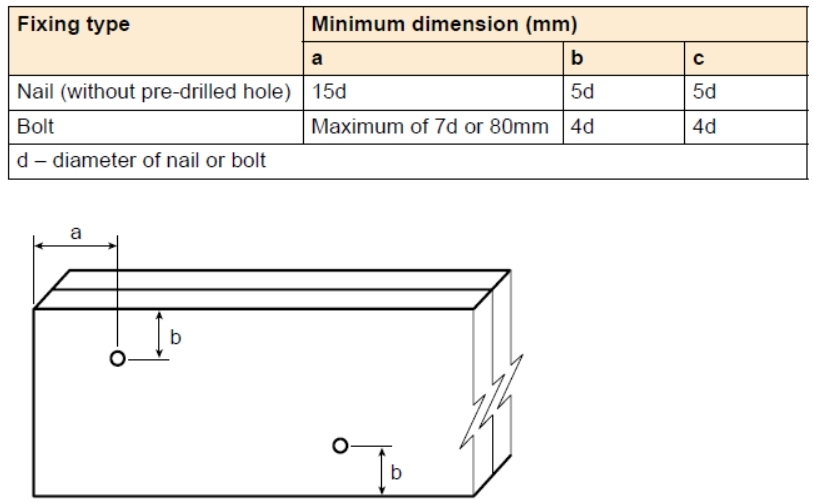
Images courtesy of Eurocode 5 Span Tables (4th edition) published by TRADA
Double member trimmers and trimming joists should be fixed in line with a minimum of two nails or two bolts at 1/3 span positions. Furthermore, as a minimum, the fixing centres (S) for double member trimmers and trimming joists should be at centres of no more than twice the joist spacing (up to a maximum of 1200mm). However, required fixing centres vary according to the total length and load on the joists.
These tables have been taken from ‘Eurocode 5 Span Tables (4th edition)’ published by TRADA to illustrate how the above works and should be consulted for any other timber sizes not shown.
No notching or drilling of trimmers or trimming joists should be carried out unless proven by calculation, other than to accommodate the flanges of joist hangers.
Further reading
Eurocode 5 Span Tables 4th edition for solid timber members in floors, ceilings and roofs for dwellings, August 2014, BM Trada, ISBN: 978-1-909594-14-2, Published by BM TRADA
Disclaimer:
Every care has been taken to ensure that the above content is correct at the time of publication. Any reliance on the content should be verified by the dutyholder(s) and their professional advisers. It is the responsibility of the dutyholder(s) and/or person carrying out the work to ensure compliance with the relevant building regulations and associated legislation.
This content is given in good faith by LABC. It is not definitive, and compliance will be a matter for the relevant building control authority to decide as the enforcing body for the building regulations, and ultimately for the appropriate tribunal or court to determine.
TT_8.1


