How to get it right: Roof truss "alterations" (or why not to cut your roof trusses!)
07.11.2018

Article updated on 31 January 2024
Roof trusses offer a quick and efficient alternative to a conventional timber roof but they're quite delicate when not in their fully braced vertical position.
They work through a combination of tension and compression to ensure that the timber chords and web sizes can be kept to a minimum and keep costs down.
The central "W" shape is how most of the loads are distributed and this is where longitudinal and diagonal bracing is needed to reinforce the roof diaphragm.
So imagine the shock one of our Registered Building Inspectors had when they encountered this roof:
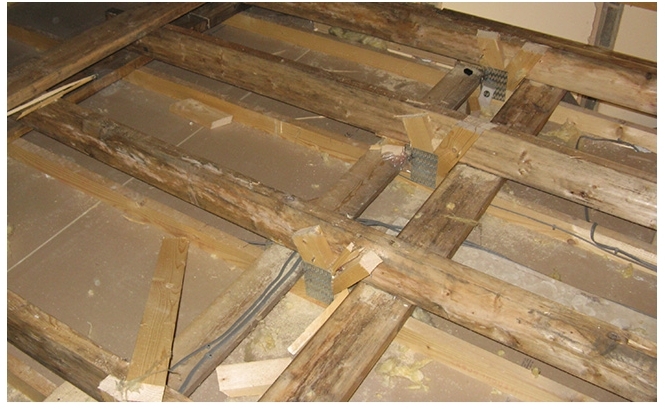
The owner had decided to carry out their own loft conversion for a bit more space and just removed the central web chords that were "getting in the way".
Once the web chords had been cut, instead of transferring all roof and wind loads to the wallplate they were taken down the internal walls. The owners called a builder in when they noticed cracking in the bedroom walls within days of the "alteration".
Trusses are always built with an upward camber so that once loaded they deflect about 6mm over time to become straight.
Without the internal walls, the calculated deflection would have been as much as 170mm but only whilst the gang nail truss connectors stayed in place.
So how was it fixed?
The roof tiles had to be taken off completely to allow the remedial work and the ceilings were propped down to the ground floor so that they could be retained in place while new trusses were inserted alongside, and bolted to the trimmed roof members.
The buildings insurance providers refused the home owner's claim leaving them with a very expensive repair bill and nothing to show for it...
Disclaimer:
Every care has been taken to ensure that the above content is correct at the time of publication. Any reliance on the content should be verified by the dutyholder(s) and their professional advisers. It is the responsibility of the dutyholder(s) and/or person carrying out the work to ensure compliance with the relevant building regulations and associated legislation.
This content is given in good faith by LABC. It is not definitive, and compliance will be a matter for the relevant building control authority to decide as the enforcing body for the building regulations, and ultimately for the appropriate tribunal or court to determine.
LABC – Application and use of Member Guidance Notes LABC is a membership organisation, providing guidance and support to its member local authorities around England and Wales. LABC is unable to comment on the application and enforcement of the Building Regulations or other building safety related legislation to a particular proposal, as this is a matter for the local authority in whose jurisdiction the building work is being carried out or, in the case of High-Risk Buildings (HRBs), the Building Safety Regulator (BSR) and for the courts to rule upon.
TT_105.1


