How to get it right: Using reinforcement in your foundations
07.08.2018

One of our surveyors had a bit of a shock recently when visiting a site for a domestic extension.
They were called out to inspect reinforcement prior to concreting foundations but hadn’t been to site previously for an excavation or commencement inspection. The ‘builder’ proudly stood back and informed the officer that he had dug down 450mm but was still into filled ground so had decided to construct a reinforced raft foundation instead.
Better still, he was helping the environment by recycling shopping trolleys for the reinforcement.
"Every little helps" replied a bemused officer before explaining what was wrong. The project was subsequently abandoned because of the additional cost of doing it correctly and it reverted back to a patio area.
If you’re involved in constructing a raft foundation then there are some key factors that need to be considered to ensure that the reinforcement fabric is correctly installed. It’s an alternative if you can’t use a traditional strip or trench fill foundations but it's important to note that raft foundations aren’t suitable in all cases and usually need designing by a competent structural engineer.
Unlike suspended floors or strip foundations where mesh is just placed in the bottom of the concrete to act in tension, rafts usually have mesh in the top to resist compression from heavy point loads like internal walls and in the bottom for tension to spread the load across a wider surface.
Reinforcement key points
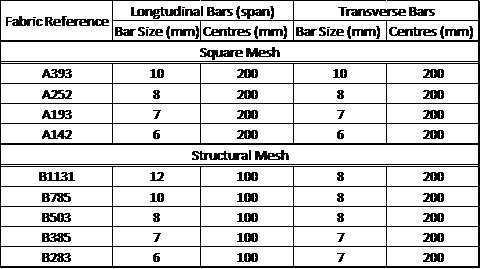
- Reinforcement comes in different sizes and grades but the most commonly used are 'A' and 'B' grade reinforcement. The table below shows you the bar sizes and centres for those commonly used:
- Reinforcing fabric should be free from loose rust, oil, grease, mud and any other contaminants that may affect the durability of the concrete.
- Carbonation reduces the corrosion protection of the reinforcement by increasing porosity and decreasing alkalinity. Such corrosion can be reduced by providing as much concrete cover as possible. The appropriate level of concrete cover for reinforcement depends on the exposure of the concrete and its application – and is summarised below:
| Application (concrete position) | Minimum cover (mm) |
| Concrete in direct contact with the ground | 75 |
| All external applications e.g. shuttered walling | 50 |
| Floor slabs and other applications where concrete is cast onto a membrane | 40 |
| Concrete over blinding | 40 |
| Internal conditions | 25 |
Table courtesy of LABC Warranty Technical Manual (version 10)
- Reinforcement should be supported by proprietary chairs or spacers and can be made of concrete, plastic or steel. The thickness and depth of a concrete spacer should not exceed 50mm x 50mm. Spacers should be placed at a maximum of 1m centres, and when supporting mesh should be staggered to avoid planes of weakness in the concrete.
- Supports for top layers of reinforcement should also be chairs, or other proprietary products, and positioned to ensure that the top layer is sufficiently held in place and doesn’t just sink through the concrete (particularly when it's being poured or tamped down and walked over) and keeps the minimum cover to the surface.
- 'A’ grade reinforcement is usually specified where loading is limited and anti-cracking measures are needed. Whereas ‘B’ grade reinforcement is intended for structural uses where the loading is higher. ‘B’ grade reinforcement can be identified by the size of the longitudinal and transverse bars with the longitudinal bars spaced at 100mm centres and are always placed in the direction of span. Transverse bars are spaced at 200mm centres.
- Where reinforcement fabric overlaps the rule of thumb is a minimum overlap of two bars plus 50mm; however, laps should be designed by a competent structural engineer or suitable guidance followed such as Table 2 in the LABC Warranty Technical Standards which provides minimum lap dimensions for B fabric reinforcement.
- Laps should all be tied using wire binding.
Please note: LABC do not advocate the use of shopping basket/trolley mesh in foundations!
Disclaimer:
Every care has been taken to ensure that the above content is correct at the time of publication. Any reliance on the content should be verified by the dutyholder(s) and their professional advisers. It is the responsibility of the dutyholder(s) and/or person carrying out the work to ensure compliance with the relevant building regulations and associated legislation.
This content is given in good faith by LABC. It is not definitive, and compliance will be a matter for the relevant building control authority to decide as the enforcing body for the building regulations, and ultimately for the appropriate tribunal or court to determine.
LABC – Application and use of Member Guidance Notes LABC is a membership organisation, providing guidance and support to its member local authorities around England and Wales. LABC is unable to comment on the application and enforcement of the Building Regulations or other building safety related legislation to a particular proposal, as this is a matter for the local authority in whose jurisdiction the building work is being carried out or, in the case of High-Risk Buildings (HRBs), the Building Safety Regulator (BSR) and for the courts to rule upon.
TT_106.1


