And the problem with these stair treads is..?
17.06.2025

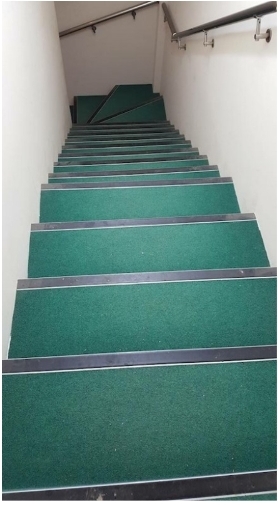
Spotted the problem yet?
It's not an optical illusion, the stair treads increase in depth (the going) as you reach the top of the flight.
Some might not view this as a problem. What's wrong with being able to fit your whole foot on the tread anyway?
The potential for injury on this stairway
For anyone unsteady on their feet or partially sighted, the change to a thinner step may cause them to lose balance and fall.
The higher up the flight, the greater risk of serious injury.
That’s why you also need a full width landing at the top and bottom of a flight and can only have a door swing reducing the landing to 400mm clearance at the bottom (dwellings only).
It is also the only part of the building regulations where a head height is stipulated for domestic properties.
The 2m head height is to prevent hitting your head at the top of the stair or on the bulkhead and falling.
The solution
In this instance it was a concrete stair and relatively easy to overcome.
Packing pieces were used to reduce the tread depth to a consistent going with the rest of the stairs and this also gave a larger landing at the top.
Where to find guidance.
Approved Document K (England) and Approved Document K (Wales) give guidance on how to design and construct stairs so they are safe for people moving between different levels within or about buildings. The dimensions for the rise and going of steps differ slightly between nations so you need to make sure the correct Approved Document is being referenced depending on location.
Disclaimer:
Every care has been taken to ensure that the above content is correct at the time of publication. Any reliance on the content should be verified by the dutyholder(s) and their professional advisers. It is the responsibility of the dutyholder(s) and/or person carrying out the work to ensure compliance with the relevant building regulations and associated legislation.
This content is given in good faith by LABC. It is not definitive, and compliance will be a matter for the relevant building control authority to decide as the enforcing body for the building regulations, and ultimately for the appropriate tribunal or court to determine.
TT_44.1


