How to get it right: Notches & holes in solid timber joists
16.11.2018

When installing pipework or cabling, floor or ceiling joists may need to be notched or drilled. But this could weaken the floor to such an extent that it becomes structurally unsound.
To find out if this might be the case, you can find guidance on notches and holes in solid timber joists for use in domestic properties in section 3.2.2 of Eurocode 5 published by BM TRADA.
The diagrams and tables below illustrate the zones and sizes permissible for differing spans and joist depths.
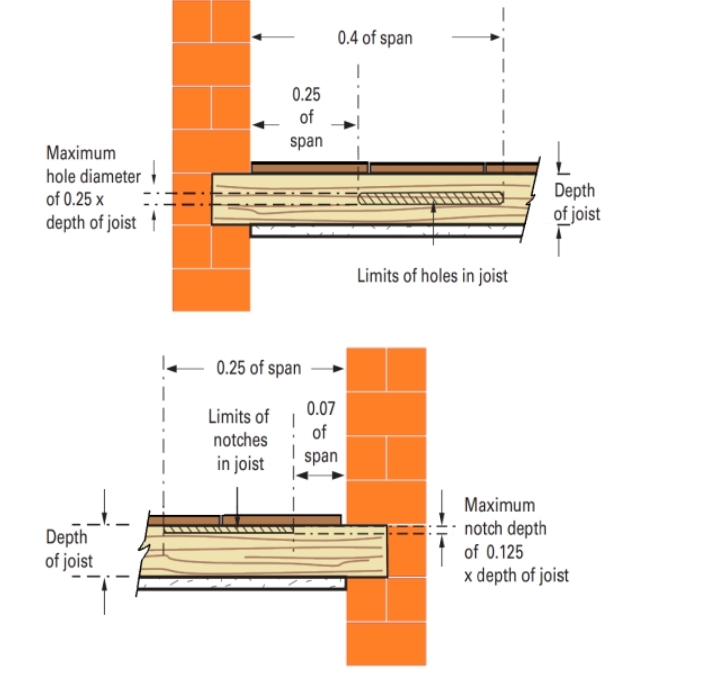
| Span of timber | Hole locations between | Notching locations between | ||
|---|---|---|---|---|
| mm | 0.25 of span | 0.4 of span | 0.07 of span | 0.25 of span |
| 2000 | 500 | 800 | 140 | 500 |
| 2500 | 625 | 1000 | 175 | 625 |
| 3000 | 750 | 1200 | 210 | 750 |
| 3500 | 875 | 1400 | 245 | 875 |
| 4000 | 1000 | 1600 | 280 | 1000 |
| 4500 | 1125 | 1800 | 315 | 1125 |
| Depth of timber | Max hole diameter | Max notch depth |
|---|---|---|
| mm | 0.25 x depth mm | 0.125 x depth mm |
| 100 | 25.0 | 12.5 |
| 125 | 31.3 | 15.6 |
| 150 | 37.5 | 18.8 |
| 175 | 43.8 | 21.9 |
| 200 | 50.0 | 25.0 |
| 225 | 56.3 | 28.1 |
| 250 | 62.5 | 31.3 |
| 275 | 65 (max) | 34.4 |
| 300 | 65 (max) | 35 (max) |
Key points for notches and holes
Before you start work check that the joist size is adequate for the span.
Notches can only be made in the top OR bottom of the joists, (not both) within the permitted area to a maximum of 35mm.
Holes may only be made on the joist's centreline within the permitted area to a maximum diameter of 65mm.
Additional holes must be at least three diameters (centre to centre) apart.
Single/multiple timber structural beams, rafters, purlins and binders must never be notched or drilled without calculations to justify the remaining timber. Rafters may be birdsmouthed by no more than 1/3rd of the depth.
This guidance does not apply to engineered joists e.g. JJI joists and reference should be made to specific product manufacturers instructions.
Disclaimer:
Every care has been taken to ensure that the above content is correct at the time of publication. Any reliance on the content should be verified by the dutyholder(s) and their professional advisers. It is the responsibility of the dutyholder(s) and/or person carrying out the work to ensure compliance with the relevant building regulations and associated legislation.
This content is given in good faith by LABC. It is not definitive, and compliance will be a matter for the relevant building control authority to decide as the enforcing body for the building regulations, and ultimately for the appropriate tribunal or court to determine.
TT_7.1


