What has the X factor got to do with building regulations?
12.12.2017

The X factor has become an established part of Saturday night television since starting in 2004. But did you know that the X factor has been in Approved Document A (Structure) since it was first introduced back in 1985?
While a structural engineer can finely tune your design, you can use the really useful table below to help determine minimum pier and return sizes to ensure the stability of masonry without needing the need for structural calculations.
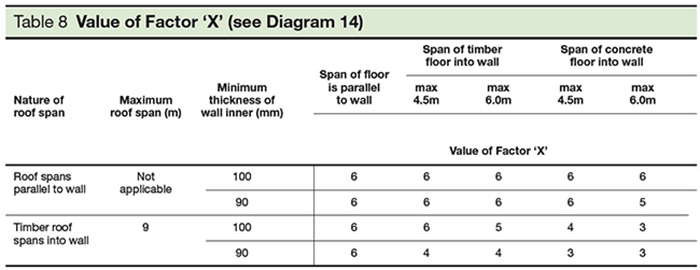
In reality the table is a fail-safe that has taken design loads and included a safety factor to ensure it’s stable in all situations.
For example if a roof with a maximum 9m span bears onto the wall and the inner masonry leaf is at least 100mm thick and at least a 7.3N/mm2 compressive strength, then the X factor is 6. If the same structure also had a first floor with a maximum 4.5m span onto it then the X factor would still be 6 or if the span is between 4.5m and 6m then the X factor would be 5 instead.
Once you know the X factor you can then use it in Diagram 14 to work out the masonry sizes:
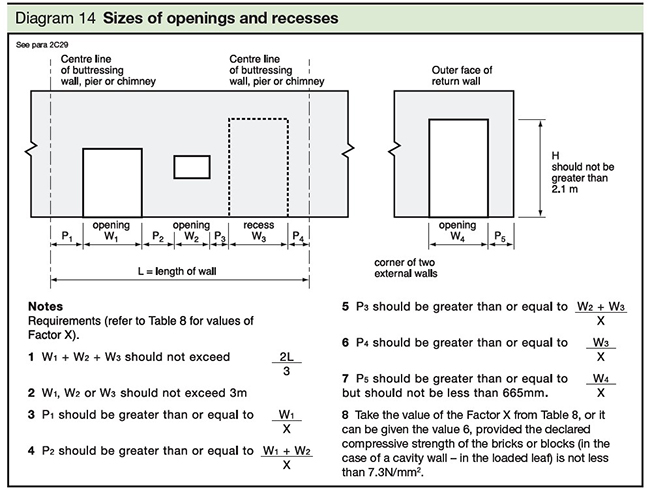
Diagram 14 has some simple rules, the main one (1) is that opening sizes are limited to 2L/3, so if the supporting wall is 6m long then the sum of the openings can’t exceed 2x6/3 = 4m.
The width of the piers are then determined using the X factor in relation to adjoining openings and the centreline of the return or buttressing walls.
If we use 6 as the X factor then we can calculate the pier sizes for a 6m long wall.
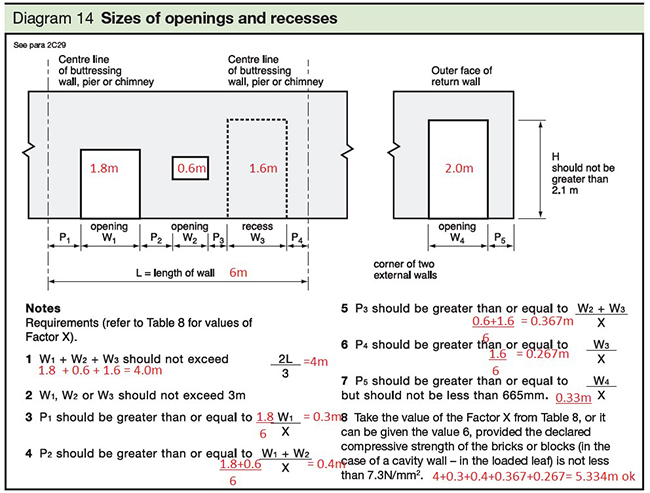
So the openings proposed all work using the formula and X factor with 666mm to spare. Larger openings can still be built but these would need a structural design that might include thicker walls or wind posts to maintain stability. It's also worth noting that the return corner pier (note 7) still needs to be at least 665mm wide despite the formula offering 330mm for W4. Remember W4 will be built in the wall buttressing the loaded wall so the 665mm brickwork return provides this stability.
So if you design your building to diagram 14 then it’s three votes from us!
Further information
View or download Part A and the rest of the Building Regulations Approved Documents:
Please Note: Every care was taken to ensure the information was correct at the time of publication. Any written guidance provided does not replace the user’s professional judgement. It is the responsibility of the dutyholder or person carrying out the work to ensure compliance with relevant building regulations or applicable technical standards.


