Landing dimensions for stairs and ramps within dwellings
16.04.2021

Building regulations require landings at the top and bottom of every stair or ramp flight. The length of the landing should be at least as long as the stair or ramp is wide. The width of a stair or ramp is defined as the clear width between the walls or balustrades.
Generally, there is no width recommendation given for stairs or ramps in dwellings, but there are exceptions to this rule.
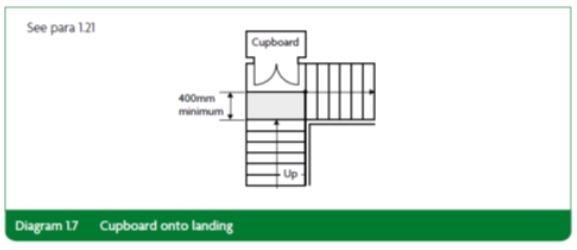
Doors to cupboards can open onto any landing if they are normally kept locked shut and a 400mm length of landing beyond the last riser or edge of ramp flight remains unobstructed when the doors are opened.
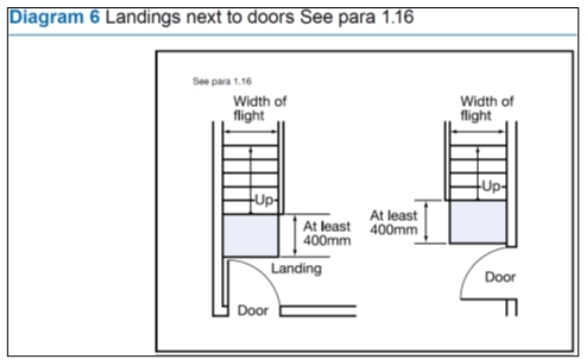
Other doors in a dwelling may swing across the landing at the bottom of ramp or stair flights but not intermediate landings or landings at the top of the stair or ramp. Again, there should be a 400mm length of landing as explained above.
Exceptions where landing dimensions are recommended
Where a dwelling is built on a severely sloping plot of land in Wales, a stepped change of level within the entrance storey is allowed where unavoidable. In this situation, the stair should be at least 900mm wide and a corresponding 900mm landing length should be provided. The standard condition door obstruction guidance given above still applies. You should not make alterations that change this dimension for the worse.
Where an optional access standard is required for a home built in England to create a category 2 accessible and adaptable dwelling, the minimum landing width for circulation purposes is 900mm and the minimum length of landing is 850mm due to the minimum stair width recommendation for this type of property. The standard condition door obstruction guidance given above does not apply in this situation.
Where an optional access standard is required for a home built in England to create a category 3 wheelchair user dwelling, the minimum landing width for circulation purposes is 1050mm and the minimum length of landing is 850mm due to the minimum stair width recommendation for this type of property. The standard condition door obstruction guidance given above does not apply in this situation.
You can make alterations to optional standard homes so that they meet the standard conditions when the work is completed.
Disclaimer:
Every care has been taken to ensure that the above content is correct at the time of publication. Any reliance on the content should be verified by the dutyholder(s) and their professional advisers. It is the responsibility of the dutyholder(s) and/or person carrying out the work to ensure compliance with the relevant building regulations and associated legislation.
This content is given in good faith by LABC. It is not definitive, and compliance will be a matter for the relevant building control authority to decide as the enforcing body for the building regulations, and ultimately for the appropriate tribunal or court to determine.
LABC – Application and use of Member Guidance Notes LABC is a membership organisation, providing guidance and support to its member local authorities around England and Wales. LABC is unable to comment on the application and enforcement of the Building Regulations or other building safety related legislation to a particular proposal, as this is a matter for the local authority in whose jurisdiction the building work is being carried out or, in the case of High-Risk Buildings (HRBs), the Building Safety Regulator (BSR) and for the courts to rule upon.
TT_97.1


